Windshield tint in Nevada is legal only in specific situations, and the rules are more precise than the common advice to “stay above the AS-1 line.” Nevada law allows transparent material on the topmost portion of the windshield when its bottom edge meets a measurement tied to the driver’s seat, and the material cannot be red or amber. Broader windshield tint may require an approved exemption.
For drivers in Las Vegas, NV, Henderson, NV, Summerlin, NV, Enterprise, NV, and nearby communities, this matters before choosing a windshield strip or asking for heat-rejecting film across more of the glass.
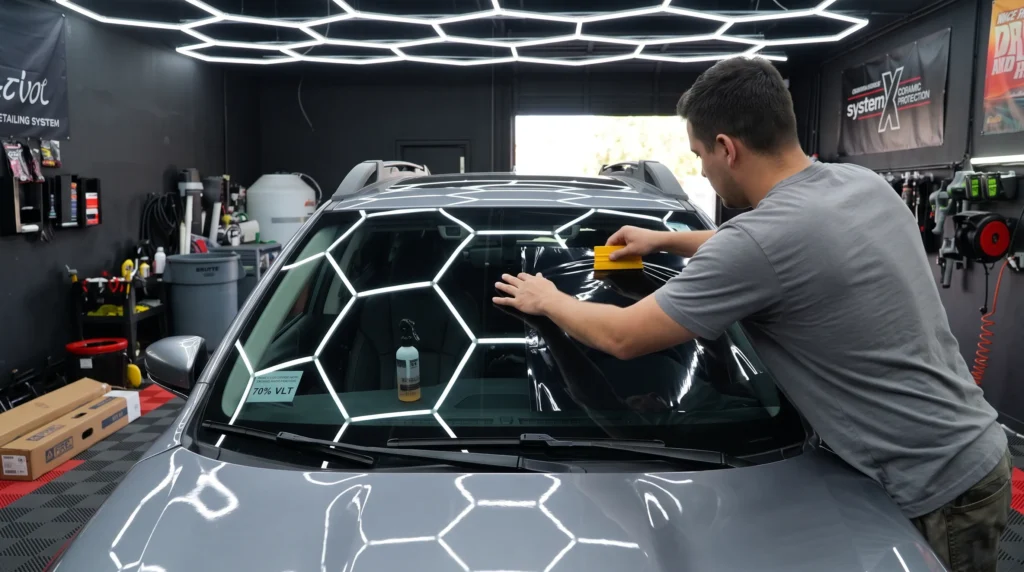
At Daily Details Garage, we install LLumar Window Tint Film and help vehicle owners understand the difference between side-window tint and windshield tint. The windshield has its own Nevada rules, so a legal setup should be planned separately from the rest of the vehicle.
Table of Contents
- Is Windshield Tint Legal in Nevada?
- What Nevada Law Says About Windshield Tint
- How Nevada Measures the Legal Windshield Tint Area
- Does Nevada Use the AS-1 Line Rule?
- Can You Tint the Entire Windshield in Nevada?
- What Colors Are Banned on the Windshield?
- Can You Use Clear Ceramic Tint on a Nevada Windshield?
- Does a High-VLT Film Automatically Make Full Windshield Tint Legal?
- What About Medical Exemptions for Windshield Tint?
- How Dark Can a Medical Exemption Go?
- What Paperwork Must Be Kept in the Vehicle?
- How Do Nevada Side-Window Rules Compare?
- Why Windshield Tint Is Popular in Las Vegas
- Windshield Strip vs Full Windshield Film
- What to Ask Before Tinting Your Windshield
- LLumar Window Tint in Las Vegas
- Frequently Asked Questions
- Sources
Is Windshield Tint Legal in Nevada?
Yes, but windshield tint in Nevada is not treated the same as tint on your side or rear windows.
Nevada Revised Statutes 484D.440 allows transparent material on the topmost portion of the windshield when the installation meets a specific height requirement. The material in that permitted area also cannot be red or amber.
That means a windshield strip can be legal when it stays within the area described by Nevada law.
The statute does not create a general rule saying any shade can cover the entire windshield just because it is light enough to see through.
That distinction is where a lot of confusion starts.
Someone may hear that a very light ceramic film is “basically clear” and assume it can legally cover the entire windshield. Nevada law is based on placement and exemptions, not only on how light the film looks.
What Nevada Law Says About Windshield Tint
The main law governing windshield tint in Nevada is NRS 484D.440.
Nevada generally prohibits placing transparent material on the windshield or other vehicle glass when that material alters color or reduces light transmission, unless the installation falls under one of the exceptions listed in the statute.
One of those exceptions covers the topmost portion of the windshield.
For that windshield area, Nevada law says the transparent material may be installed when:
- The bottom edge is not less than 29 inches above the undepressed driver’s seat, using the measurement method written into the statute.
- The material is not red or amber.
The law gives more detail than many short tint-law charts found online.
If you want to know whether your planned windshield strip fits the Nevada rule, the actual statutory measurement is the better reference.
How Nevada Measures the Legal Windshield Tint Area
The most unusual part of windshield tint in Nevada is the way the state defines the permitted upper portion.
Nevada does not simply say “six inches from the top.”
NRS 484D.440 says the bottom edge of the transparent material must be at least 29 inches above the undepressed driver’s seat.
The statute then explains how that measurement is taken.
The driver’s seat must be:
- In its rearmost position
- In its lowermost position
- Undepressed
- Inside a vehicle sitting on a level surface
The measurement starts from a point 5 inches in front of the bottom of the seat backrest.
That is far more exact than simply estimating a strip from the top of the glass.
What this means for Las Vegas, NV drivers is that the legal strip area can depend on vehicle design and seating position.
A sports coupe with a low seating position may not relate to the rule in the same way as a large SUV or pickup.
Does Nevada Use the AS-1 Line Rule?
People often describe legal windshield tint by referring to an AS-1 line marked on some windshields.
That shorthand appears frequently in tint discussions, but Nevada’s statute uses its own measurement language.
For windshield tint in Nevada, the law refers to the topmost portion of the windshield and the 29-inch measurement tied to the driver’s seat.
It does not simply say, “Tint is legal above the AS-1 line.”
That is why repeating a national tint chart without reading Nevada’s statute can create confusion.
If you want a windshield strip, ask the installer how the planned placement relates to Nevada’s written rule for your vehicle.
Can You Tint the Entire Windshield in Nevada?
For a standard vehicle without an approved exemption, Nevada law does not provide the same broad permission for full-windshield tint that it gives for the permitted top strip.
The statute’s windshield exception focuses on that topmost portion.
So if someone asks whether full windshield tint in Nevada is legal simply because the film is very light, the answer is not as simple as saying yes.
A high visible-light-transmission film may look nearly clear, but Nevada law still controls where material that alters color or reduces light transmission can be installed.
A qualifying medical exemption is a separate path under Nevada rules.
Before installing film across an entire windshield, drivers should review the current law and any exemption requirements that apply to their situation.
What Colors Are Banned on the Windshield?
Nevada specifically restricts two colors in the permitted upper windshield area.
The material cannot be:
- Red
- Amber
This restriction appears directly in the windshield portion of NRS 484D.440.
So even if the film stays within the permitted top area, a red or amber film does not meet that part of the rule.
For most drivers interested in windshield tint in Nevada, this is not a major concern because automotive films commonly used for glare and solar control are neutral in appearance.
Still, the color rule is part of Nevada law and should not be left out when discussing legal windshield tint.
Can You Use Clear Ceramic Tint on a Nevada Windshield?
Clear or very light ceramic film raises one of the most common questions about windshield tint in Nevada.
Ceramic film can be made with high visible light transmission while still providing solar-control benefits.
That can sound ideal for Las Vegas drivers who want less heat without making the windshield look dark.
The legal issue is separate from the film’s heat performance.
A nearly clear ceramic film can still reduce light transmission or change the optical properties of the glass. Nevada’s law controls the placement of that material unless an exception applies.
So the fact that a ceramic windshield film looks clear does not by itself make a full-windshield installation legal.
If you are considering ceramic film for the windshield, discuss both the product specifications and Nevada placement rules before booking the work.
Does a High-VLT Film Automatically Make Full Windshield Tint Legal?
No.
This is one of the biggest misunderstandings surrounding windshield tint in Nevada.
VLT stands for visible light transmission. A film with a high VLT lets a large amount of visible light pass through.
A high VLT can make film appear very light or nearly clear.
Nevada’s windshield rule is not written as a simple “anything above X percent is legal across the whole windshield” standard.
The windshield exception focuses on placement.
That means choosing a 70%, 80%, or similarly light film does not automatically create permission for full windshield coverage.
Vehicle owners should not confuse “light film” with “legal everywhere on the windshield.”
What About Medical Exemptions for Windshield Tint?
Nevada provides an exemption process for certain drivers.
Nevada Administrative Code 484D.280 through 484D.290 covers applications for exemptions from the state’s tint standards.
For a medical exemption, Nevada rules require a sworn statement from the applicant’s treating physician stating that the person has a medical condition requiring transparent material on the windshield or side or rear windows.
The applicant must also provide a sworn statement that he or she is the main driver of the vehicle.
Nevada DMV lists Form DO 200, Application for Window Tint Exemption, for people seeking approval.
The tint shop does not issue the exemption.
Approval comes through the state process.
If you believe you qualify, handle the exemption paperwork before treating medical need as permission for a darker or broader installation.
How Dark Can a Medical Exemption Go?
Nevada’s current DO 200 exemption form states that no window tint exemption below 20% VLT will be approved by the Department of Public Safety.
That does not mean everyone with a medical condition automatically qualifies for 20% tint.
It means the state form sets 20% VLT as the lower boundary for approvals under that process.
Applicants still need to qualify and submit the required documentation.
The approved exemption also needs to identify the vehicle and authorized setup.
For anyone researching windshield tint in Nevada because of a medical condition, the DMV form and Nevada Administrative Code are better references than informal online advice.
What Paperwork Must Be Kept in the Vehicle?
Nevada’s DO 200 form states that, once approved, the original authorization or a copy must be carried in the vehicle.
That matters because an approved exemption is tied to state documentation.
A driver’s explanation that a doctor recommended tint is not the same thing as carrying the approved exemption required by the state process.
If you receive approval, keep the required paperwork with the vehicle.
It is also wise to keep documentation showing which film was installed and its VLT.
How Do Nevada Side-Window Rules Compare?
Side windows follow different rules from windshield tint in Nevada.
For the windows immediately to the right and left of the driver, NRS 484D.440 allows nonreflective tint when the total light transmission through the film and safety glass is at least 35%, with a 7% tolerance.
Rear-side windows and rear glass are covered by another provision when the vehicle has outside mirrors on each side that provide the required rearward view.
The main point is that Nevada does not apply one single tint percentage to every piece of glass.
You should think of the vehicle in separate zones:
- Windshield
- Front side windows
- Rear side windows
- Rear glass
Each area has its own legal treatment.
You can learn more about side-window options on our window tint service page.
Why Windshield Tint Is Popular in Las Vegas
Las Vegas, NV drivers deal with strong sunlight for much of the year.
That makes the windshield a natural area of interest because it is one of the largest pieces of glass on most vehicles.
Drivers often ask about windshield film because they want:
- Less glare
- Lower solar heat transmission
- UV filtering
- More comfortable daytime driving
- A windshield strip that cuts overhead sunlight
Ceramic films can be appealing because they are designed to target solar and infrared energy without requiring an extremely dark appearance.
Still, legal placement comes first.
A film’s ability to reject heat does not change Nevada’s windshield rules.
For drivers from Henderson, NV, Summerlin, NV, Enterprise, NV, and other areas around the valley, a legal windshield strip may be one option worth discussing.
Windshield Strip vs Full Windshield Film
A windshield strip and full windshield film are very different jobs under Nevada law.
Windshield Strip
A windshield strip covers the top portion of the glass.
Nevada law has a specific exception for transparent material in this area when the bottom edge meets the statutory measurement and the film is not red or amber.
This is the clearest legal path for a standard windshield-tint installation without an exemption.
Full Windshield Film
Full windshield film covers nearly all of the glass.
Even if that film is very light, the standard Nevada windshield exception does not simply authorize unrestricted full coverage.
Drivers considering full windshield film should understand whether they have an approved exemption or another lawful basis for the installation.
The real question is not only how dark the film looks.
It is whether the placement fits Nevada law.
What to Ask Before Tinting Your Windshield
Before booking windshield tint in Nevada, ask the shop a few direct questions.
What part of the windshield will be covered?
Find out whether you are getting a legal top strip or broader coverage.
How does the placement match NRS 484D.440?
A shop should understand that Nevada uses a specific windshield measurement.
What film brand and product line are being installed?
Daily Details Garage installs LLumar Window Tint Film.
Knowing the exact film lets you review manufacturer specifications.
What is the film’s VLT?
Ask for the published visible light transmission.
Is it ceramic or another film type?
If your concern is Las Vegas heat, the type of film matters.
Does the installation require an exemption?
If the proposed coverage goes beyond the standard windshield-strip rule, determine whether an approved state exemption is needed.
What warranty comes with the film?
Ask what coverage comes from the film manufacturer and installer.
Good questions before installation can prevent confusion after the film is already on the vehicle.
LLumar Window Tint in Las Vegas
Daily Details Garage installs LLumar Window Tint Film at:
5160 S Valley View Blvd Ste 108 Las Vegas, NV 89118
We serve vehicle owners from Las Vegas, NV, Henderson, NV, Summerlin, NV, Enterprise, NV, and surrounding parts of the Las Vegas Valley.
Our Las Vegas window tint service includes options for side windows, rear glass, windshield strips, and other tint needs based on the vehicle and planned installation.
If you are considering windshield tint in Nevada, tell us:
- Your vehicle year
- Make
- Model
- The windshield coverage you want
- Whether heat rejection is your main concern
- Whether you have an approved exemption
- Whether other windows also need tint
Daily Details Garage also provides:
We install Llumar Paint Protection Film and are System X certified for ceramic coating services.
Call (702) 501-6585 or visit the Daily Details Garage contact page to discuss your window tint appointment.
Frequently Asked Questions
1. Is windshield tint legal in Nevada?
Yes, windshield tint in Nevada is allowed on the topmost portion of the windshield when it meets the placement rules in NRS 484D.440. The bottom edge must meet Nevada’s 29-inch measurement rule, and the material cannot be red or amber.
2. Can I tint my whole windshield in Nevada?
Nevada’s standard windshield exception applies to the topmost portion of the windshield. A very light film does not automatically make full windshield coverage legal. Certain drivers may qualify for a state-approved exemption.
3. How far down can windshield tint go in Nevada?
Nevada does not use a simple number of inches measured down from the top. The law states that the bottom edge of the material must be at least 29 inches above the undepressed driver’s seat using the measurement method described in NRS 484D.440.
4. Does Nevada use the AS-1 line for windshield tint?
Nevada’s statute uses its own measurement tied to the driver’s seat rather than relying only on the AS-1 line. Drivers should follow the language in NRS 484D.440 when determining the legal upper windshield area.
5. Is clear ceramic windshield tint legal in Nevada?
The fact that a film is clear or has a high VLT does not automatically make full windshield coverage legal. Nevada controls where transparent material that reduces light transmission or alters color may be placed. Review the statute before installing film beyond the permitted upper area.
6. Can I get a medical exemption for windshield tint in Nevada?
Nevada has a tint exemption process. Applicants seeking a medical exemption need supporting sworn statements and must submit the required state application. The current DO 200 form states that exemptions below 20% VLT will not be approved.
7. Where can I get windshield tint in Las Vegas, NV?
Daily Details Garage installs LLumar Window Tint Film at 5160 S Valley View Blvd Ste 108, Las Vegas, NV 89118. Call (702) 501-6585 or visit our contact page to discuss a windshield strip or other tint options for your vehicle.
Sources
- NRS 484D.440: Restrictions on Tinting of Windshield or Side or Rear Window
Publisher: Nevada Legislature
Publication Date: Current online Nevada Revised Statutes, accessed August 21, 2026
URL: https://www.leg.state.nv.us/nrs/NRS-484D.html - NRS 597.710: Required Notice for Installation of Window Tint
Publisher: Nevada Legislature
Publication Date: Current online Nevada Revised Statutes, accessed August 21, 2026
URL: https://www.leg.state.nv.us/division/legal/lawlibrary/NRS/NRS-597.html - Nevada Administrative Code Chapter 484D: Tinting of Windows
Publisher: Nevada Legislature
Publication Date: Current online Nevada Administrative Code, accessed August 21, 2026
URL: https://www.leg.state.nv.us/Division/Legal/LawLibrary/NAC/NAC-484D.html - Application for Window Tint Exemption, Form DO 200
Publisher: Nevada Department of Motor Vehicles / Nevada Department of Public Safety
Publication Date: Date not listed on form, accessed August 21, 2026
URL: https://dmv.nv.gov/pdfforms/do200.pdf - Nevada DMV Forms: Window Tinting
Publisher: Nevada Department of Motor Vehicles
Publication Date: Current web page, accessed August 21, 2026
URL: https://dmv.nv.gov/dmvforms.htm - Window Tint in Las Vegas
Publisher: Daily Details Garage
Publication Date: Current service page, accessed August 21, 2026
URL: https://dailydetailsgarage.com/services/window-tint-las-vegas/
Window Tinting Paradise NV | Daily Details Garage
Window Tinting Paradise NV | Daily Details Garage Premier Certified Installer. Want the best window tinting in Paradise, NV? Learn how to choose the right shade, film type, and installer for your car or home, plus get tips on maximizing heat rejection and UV protection.
Product Brand: Daily Details Garage
5
Pros
- Window Tinting Paradise NV | Daily Details Garage Premier Certified Installer. Want the best window tinting in Paradise, NV? Learn how to choose the right shade, film type, and installer for your car or home, plus get tips on maximizing heat rejection and UV protection.