Nevada window tint laws set limits on how much light must pass through certain vehicle windows and place separate rules on windshield tint, rear glass, and medical exemptions. For vehicle owners in Las Vegas, NV, knowing these rules before selecting window tint can help prevent choosing a setup that does not meet state requirements.
At Daily Details Garage, we install LLumar Window Tint Film for vehicle owners in Las Vegas, NV, Henderson, NV, Summerlin, NV, and nearby communities. When choosing a tint shade, appearance is only part of the decision. Nevada law also matters.
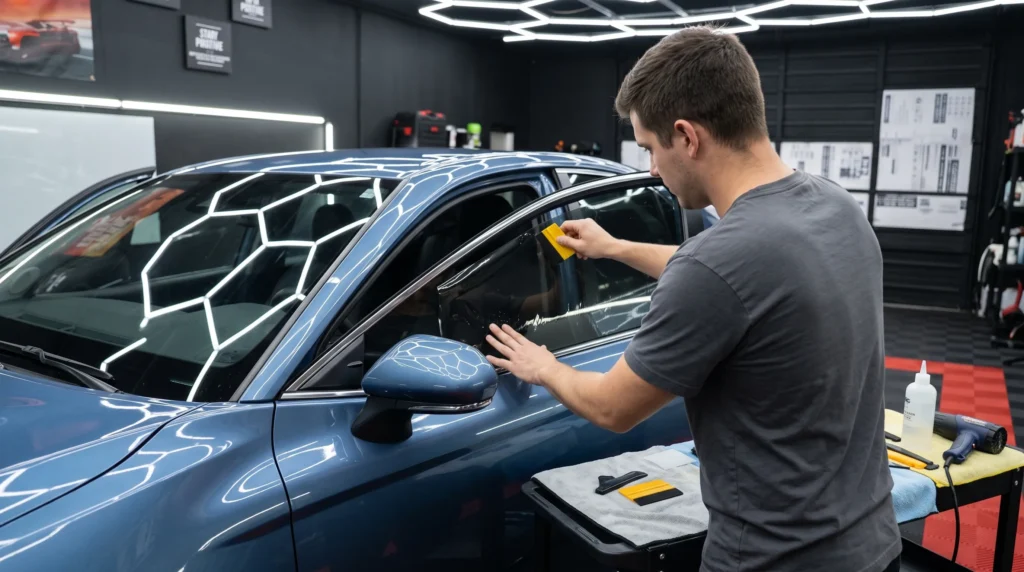
This guide breaks down Nevada window tint laws in plain language, including the 35% rule for the windows beside the driver, rear-window rules, windshield restrictions, visible light transmission, and medical exemptions.
Table of Contents
- What Do Nevada Window Tint Laws Say?
- Nevada Window Tint Laws for Front Side Windows
- What Does 35% Window Tint Mean?
- Why Total Light Transmission Matters
- Nevada Window Tint Laws for Rear Side Windows
- Nevada Window Tint Laws for the Rear Window
- Nevada Windshield Tint Laws
- Are Red or Amber Windshield Tint Strips Legal?
- Can You Have a Darker Tint With a Medical Exemption?
- Does Factory Privacy Glass Count?
- Can Window Tint Be Too Reflective in Nevada?
- Why Film Percentage and Final VLT Can Be Different
- Choosing Legal Window Tint in Las Vegas
- LLumar Window Tint at Daily Details Garage
- Frequently Asked Questions
- Sources
What Do Nevada Window Tint Laws Say?
The main statute covering Nevada window tint laws is Nevada Revised Statutes 484D.440.
Nevada law starts with a restriction against applying transparent material that alters the color or reduces the light transmission of the windshield or side or rear windows on vehicles required to be registered in Nevada.
The statute then lists situations where tint is allowed.
For most passenger vehicle owners, the parts that matter most cover:
- Front side windows
- Rear side windows
- Rear glass
- The top portion of the windshield
- Factory-installed materials
- Approved exemptions
The rules are not identical for every piece of glass.
Here is why that matters. A tint percentage that may be allowed on a rear side window is not automatically allowed on the window directly beside the driver.
Nevada Window Tint Laws for Front Side Windows
One of the most searched parts of Nevada window tint laws is the rule for the two windows immediately beside the driver.
Under NRS 484D.440, a window immediately to the right or left of the driver may have tint when:
- The material is nonreflective.
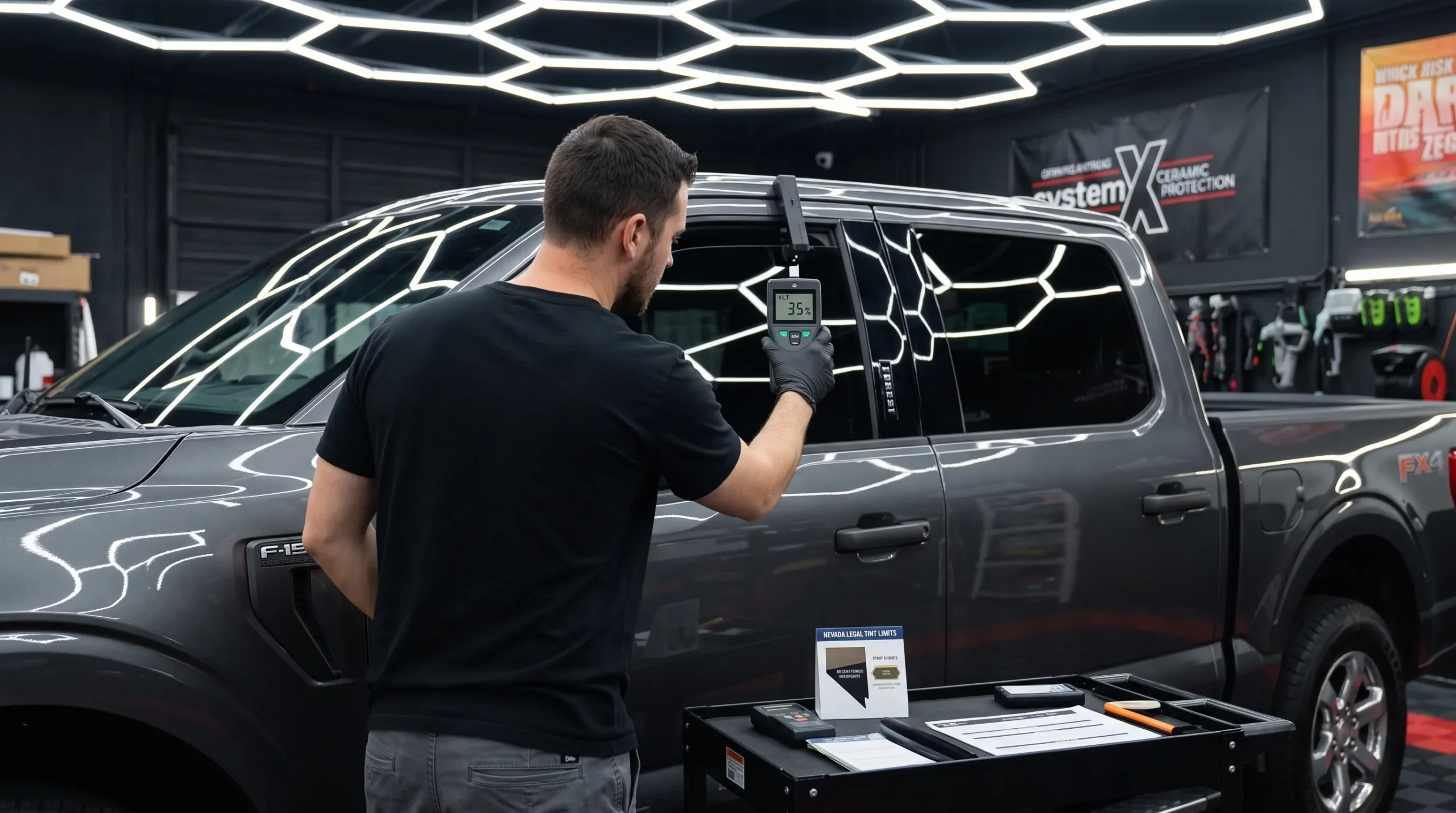
- The total light transmission through the film and safety glass is at least 35%, with a 7% tolerance.
That means the law is looking at the finished glass and film combination rather than simply reading the percentage printed on a film box.
If you are selecting window tint in Las Vegas, this distinction matters.
A vehicle’s factory glass may already reduce a portion of incoming light before aftermarket tint is installed.
What Does 35% Window Tint Mean?
Visible light transmission, commonly shortened to VLT, describes how much visible light passes through glass and tint.
A higher VLT number allows more visible light through.
A lower VLT number allows less visible light through and usually looks darker.
For the front windows immediately beside the driver, Nevada window tint laws require at least 35% total light transmission, with the tolerance written into the statute.
This does not mean every product marked “35%” will produce a finished measurement of exactly 35% after installation.
The original vehicle glass plays a part in the final reading.
That is one reason it makes sense to talk with a tint installer about the finished setup rather than choosing film based only on the label.
Why Total Light Transmission Matters
The wording in NRS 484D.440 is very useful for understanding Nevada window tint laws.
The statute defines light transmission as the ratio of light allowed to pass through a product or material compared with the amount of light that falls on it.
For the front windows beside the driver, Nevada refers to the total light transmission through the combination of transparent material and safety glazing.
In plain language, the law looks at the window and tint together.
Suppose a piece of factory automotive glass already reduces some visible light. Applying a film rated at a certain VLT does not guarantee that the completed window will test at the same number.
This is one reason professionally installed tint can help vehicle owners choose a film with the finished result in mind.
Nevada Window Tint Laws for Rear Side Windows
Nevada window tint laws treat side windows behind the driver differently from the front side windows.
NRS 484D.440 allows transparent material on a side window behind the driver when the vehicle has outside mirrors on both sides positioned to show the driver a view of the highway through each mirror for at least 200 feet behind the vehicle.
The statute does not place the same 35% language on those rear side windows that it places on the windows immediately beside the driver.
The mirror requirement is a major part of this rule.
This is useful for owners of SUVs, trucks, vans, and other vehicles that may already have dark factory privacy glass behind the front seating area.
If you want the front glass to have an appearance closer to the rear glass, talk with your installer about a setup that stays within the rules for the front windows.
Nevada Window Tint Laws for the Rear Window
The rear window follows a similar provision.
Under Nevada window tint laws, transparent material may be placed on the rear window when the vehicle has an outside mirror on each side that gives the required rearward view.
Again, the statute calls for a view of the highway for at least 200 feet behind the vehicle through each outside mirror.
This means rear glass is not treated the same way as the front side windows.
Vehicle design still matters. Mirror placement and visibility need to meet the statutory condition.
Owners considering dark rear glass should make sure their mirrors meet the requirement rather than assuming that any rear tint setup is permitted.
Nevada Windshield Tint Laws
Windshield tint receives separate treatment under Nevada window tint laws.
NRS 484D.440 allows transparent material on the topmost portion of the windshield when two conditions are met.
First, the bottom edge of the material must be at least 29 inches above the undepressed driver’s seat.
The statute gives a precise measurement method. The measurement is taken from a point 5 inches in front of the bottom of the backrest, with the driver’s seat in its rearmost and lowermost position while the vehicle is sitting on a level surface.
Second, the material on that topmost portion cannot be red or amber.
This wording is more precise than simply saying Nevada allows tint “above the AS-1 line.”
The Nevada statute uses its own measurement standard.
If you want a windshield strip, talk with the installer about how the state rule applies to your vehicle.
Are Red or Amber Windshield Tint Strips Legal?
NRS 484D.440 states that transparent material installed on the permitted topmost portion of the windshield cannot be red or amber.
That color restriction is written directly into the windshield-strip portion of Nevada window tint laws.
Vehicle owners sometimes focus only on darkness when choosing tint, but color and placement can matter too.
If your goal is glare reduction near the top of the windshield, ask about a film and placement that fit the statute.
Can You Have a Darker Tint With a Medical Exemption?
Nevada has a process for certain window tint exemptions.
Nevada Administrative Code 484D.280 and 484D.285 describe the application requirements.
A person seeking a medical exemption must provide a sworn statement from the treating physician stating that the person has a medical condition requiring transparent material on the windshield or side or rear windows.
The applicant must also provide a sworn statement stating that he or she is the vehicle’s main driver.
Nevada DMV lists Form DO 200, Application for Window Tint Exemption for qualifying applicants.
The current state form states that no exemption below 20% VLT will be approved by the Department of Public Safety.
An exemption is not something a tint installer can issue.
Vehicle owners who believe they qualify should complete the state process and receive approval before relying on an exemption.
Does Factory Privacy Glass Count?
Factory privacy glass and aftermarket window tint are not always the same thing.
Many SUVs, crossovers, trucks, and vans have darker glass installed by the vehicle manufacturer behind the front seats.
NRS 484D.440 contains a provision covering vehicles sold new with material that met federal requirements at the time of manufacture.
That does not mean you should ignore the state limits when adding aftermarket film.
If film is being added to front side glass, the total light transmission requirement still matters.
If you already have dark factory glass and want matching front windows, tell your tint installer what vehicle you own and what appearance you want.
Daily Details Garage can discuss LLumar film choices for your car, truck, or SUV through our Las Vegas window tint service.
Can Window Tint Be Too Reflective in Nevada?
For the windows immediately to the right and left of the driver, Nevada window tint laws say the permitted transparent material must be nonreflective.
That requirement appears alongside the 35% total light transmission rule.
When choosing front-window film, darkness is not the only point to check.
The type of film matters as well.
Daily Details Garage installs LLumar Window Tint Film, including film choices suited to vehicle owners looking for privacy, glare reduction, heat rejection, or a cleaner appearance.
If you are unsure which film fits your goals and the Nevada rules, discuss the desired result before scheduling the work.
Why Film Percentage and Final VLT Can Be Different
A common mistake is assuming that a tint film marked with a certain percentage will create that exact percentage on every vehicle.
The final VLT can differ because the existing automotive glass already has its own light-transmission level.
Here is what matters.
Nevada window tint laws refer to total light transmission through the combination of the applied material and safety glazing for the front side windows.
That means two vehicles using the same film could produce slightly different meter readings if their original glass is different.
This also explains why copying another vehicle’s tint setup may not produce the same result on your car.
A film choice should be based on your vehicle, desired appearance, and applicable window position.
Choosing Legal Window Tint in Las Vegas
Living in Las Vegas, NV makes window tint appealing for many reasons.
Bright sunlight and strong glare are common parts of local vehicle use. Many owners also like window tint for added privacy and appearance.
Still, Nevada window tint laws should be part of the decision from the start.
Before scheduling tint, know which glass you want covered.
You might be considering:
- Two front windows
- Side and rear glass
- A full vehicle tint package
- A windshield strip
- Windshield film where allowed
- Removal and replacement of older tint
A vehicle owner in Henderson, NV may want to match front windows to factory rear privacy glass. Someone in Summerlin, NV may be tinting a new sedan with clear glass throughout.
The correct film choice can differ between those vehicles.
LLumar Window Tint at Daily Details Garage
Daily Details Garage installs LLumar Window Tint Film at our Las Vegas, NV shop.
Our window tint service can be used for cars, trucks, SUVs, performance vehicles, and other passenger vehicles.
Available coverage choices include front-window matching, broader vehicle coverage, windshield strips, and windshield film where the planned installation fits applicable requirements.
You can learn more on our window tint service page.
Daily Details Garage is located at:
5160 S Valley View Blvd Ste 108 Las Vegas, NV 89118
We work with vehicle owners from Las Vegas, NV, Henderson, NV, Summerlin, NV, and surrounding parts of the Las Vegas Valley.
We also provide related vehicle services, including:
Daily Details Garage installs LLumar Paint Protection Film and is System X certified for ceramic coating services.
If you are choosing window film, the first goal should be finding a setup that fits your vehicle, your preferred appearance, and Nevada window tint laws.
Call (702) 501-6585 to discuss your vehicle.
You can also visit the Daily Details Garage contact page to request an appointment.
Frequently Asked Questions
1. What is the legal window tint percentage in Nevada?
For the windows immediately to the right and left of the driver, Nevada window tint laws require nonreflective material and at least 35% total light transmission through the combined glass and film, with a 7% tolerance. Rear-side and rear windows are covered by a different provision when the vehicle has qualifying outside mirrors.
2. Is 20% tint legal in Nevada?
It depends on which window is being discussed. The front side windows immediately beside the driver are subject to the 35% total light transmission rule with the tolerance stated in NRS 484D.440. Rear-side and rear glass follow different conditions. Nevada’s current exemption form states that approved exemptions will not be issued below 20% VLT.
3. Can you tint the rear windows darker than the front windows in Nevada?
NRS 484D.440 treats rear-side windows and rear glass differently from the front windows beside the driver. Rear-side and rear glass may have transparent material when the vehicle has outside mirrors on both sides that provide the required 200-foot rearward view.
4. Can you tint your windshield in Nevada?
Nevada window tint laws permit transparent material on the topmost portion of the windshield when it meets the state’s placement rule and is not red or amber. The statute uses a measurement tied to the driver’s seat rather than relying only on a general description of a windshield strip.
5. Does Nevada allow window tint medical exemptions?
Yes. Nevada regulations provide an exemption process. A medical applicant must submit required documentation, including sworn statements from a treating physician and the applicant. Nevada DMV lists Form DO 200 for window tint exemptions.
6. Does factory privacy glass affect Nevada tint limits?
It can affect the final amount of light passing through a window. For the front windows immediately beside the driver, Nevada window tint laws refer to total light transmission through both the transparent material and safety glazing. This is why the final reading can differ from the film’s listed percentage.
7. Where can I get window tint installed in Las Vegas, NV?
Daily Details Garage installs LLumar Window Tint Film at 5160 S Valley View Blvd Ste 108, Las Vegas, NV 89118. Call (702) 501-6585 or visit our contact page to discuss tint for your vehicle.
Sources
- NRS 484D.440: Restrictions on Tinting of Windshield or Side or Rear Window
Publisher: Nevada Legislature
Publication Date: Current Nevada Revised Statutes
URL: https://www.leg.state.nv.us/nrs/NRS-484D.html - Nevada Administrative Code Chapter 484D: Tinting of Windows
Publisher: Nevada Legislature
Publication Date: Current Nevada Administrative Code
URL: https://www.leg.state.nv.us/Division/Legal/LawLibrary/NAC/NAC-484D.html - Form DO 200: Application for Window Tint Exemption
Publisher: Nevada Department of Motor Vehicles / Nevada Department of Public Safety
Publication Date: Not listed on form
URL: https://dmv.nv.gov/pdfforms/do200.pdf - Nevada DMV Forms: Window Tinting
Publisher: Nevada Department of Motor Vehicles
Publication Date: Not listed
URL: https://dmv.nv.gov/dmvforms.htm - Window Tint in Las Vegas, Summerlin & Henderson
Publisher: Daily Details Garage
Publication Date: Not listed
URL: https://dailydetailsgarage.com/services/window-tint-las-vegas/
Window Tinting Paradise NV | Daily Details Garage
Window Tinting Paradise NV | Daily Details Garage Premier Certified Installer. Want the best window tinting in Paradise, NV? Learn how to choose the right shade, film type, and installer for your car or home, plus get tips on maximizing heat rejection and UV protection.
Product Brand: Daily Details Garage
5
Pros
- Window Tinting Paradise NV | Daily Details Garage Premier Certified Installer. Want the best window tinting in Paradise, NV? Learn how to choose the right shade, film type, and installer for your car or home, plus get tips on maximizing heat rejection and UV protection.